
One orchestrator. A hierarchy of specialists.
A single orchestrating agent dispatches the right specialist for every task in the pipeline lifecycle — from first ingestion to a schema change six months later.
Orchestrator
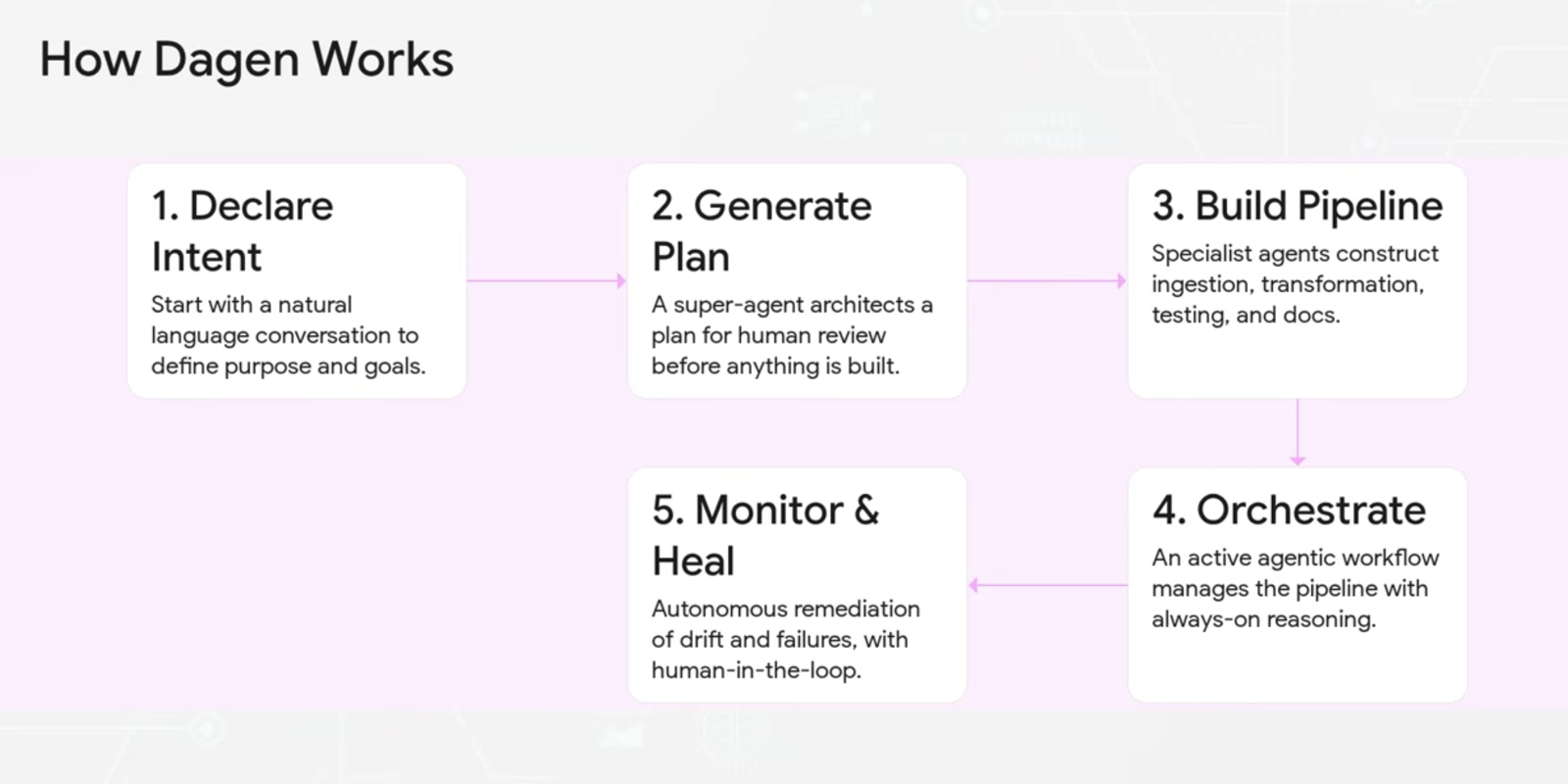
Reads the declared intent, plans the architecture, and dispatches specialist agents to build it — pausing for your approval at the level of autonomy you've set.
Build agents
Ingestion, dbt/Spark transformation, and data modeling agents turn an intent into a working, tested, documented pipeline.
Monitoring agents
Watch continuously for schema drift, data quality violations, SLA risk, and volume anomalies across every pipeline layer.
Healing agents
Diagnose the failure, rewrite the affected transformation, and reprocess — escalating to a human only at the edges of their guardrails.
From silent failure to resolved, unattended.
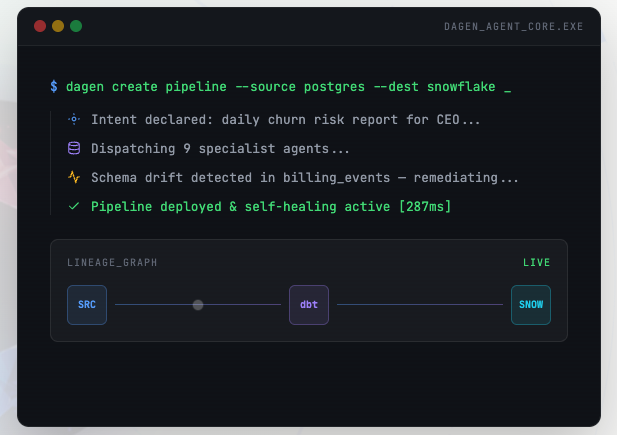
Legacy pipelines fail quietly: exit code 0, wrong answer downstream. The agentic runtime treats that as unacceptable — every stage below runs without a page going out.
Schema drift in billing_events
Type changed: DECIMAL(10,2) → VARCHAR. Three downstream models flagged as affected before any of them re-run.
Auto-rewriting affected models
Casting applied at the bronze layer. Tests regenerated. Downstream SLA windows preserved throughout.
Pipeline healthy — no human action required
The remediation is logged and the drift pattern is added to monitoring rules, so the same issue is caught earlier next time.
Define how far the runtime acts without you.
Three modes let you match autonomy to your team's comfort level, and move between them as trust builds.
Expert advisor
The runtime presents options and rationale at every decision point. Engineers stay in full control — best for high-sensitivity pipelines.
Smart collaboration
Routine decisions are handled independently. Only architectural choices and significant tradeoffs are surfaced for review.
Full autonomy
The runtime executes end to end. Humans are notified only for exceptions, anomalies, or policy violations.
Every remediation becomes institutional knowledge.
Nothing the runtime learns stays local to one incident. It's captured, structured, and available to every future pipeline — including the ones built after the engineer who knew why leaves.
What's happening right now
The active context for in-flight tasks: what's being built, what's been decided, what exceptions are open.
How we do things here
A structured log of remediations, directives, and architectural decisions — applied consistently across your whole data estate.
What we've learned over time
A persistent, organization-specific base of definitions, preferences, and tribal knowledge that informs every future decision.
Watch the runtime catch a failure, live.
In a 30-minute technical demo, watch schema drift get detected and repaired end to end, live.