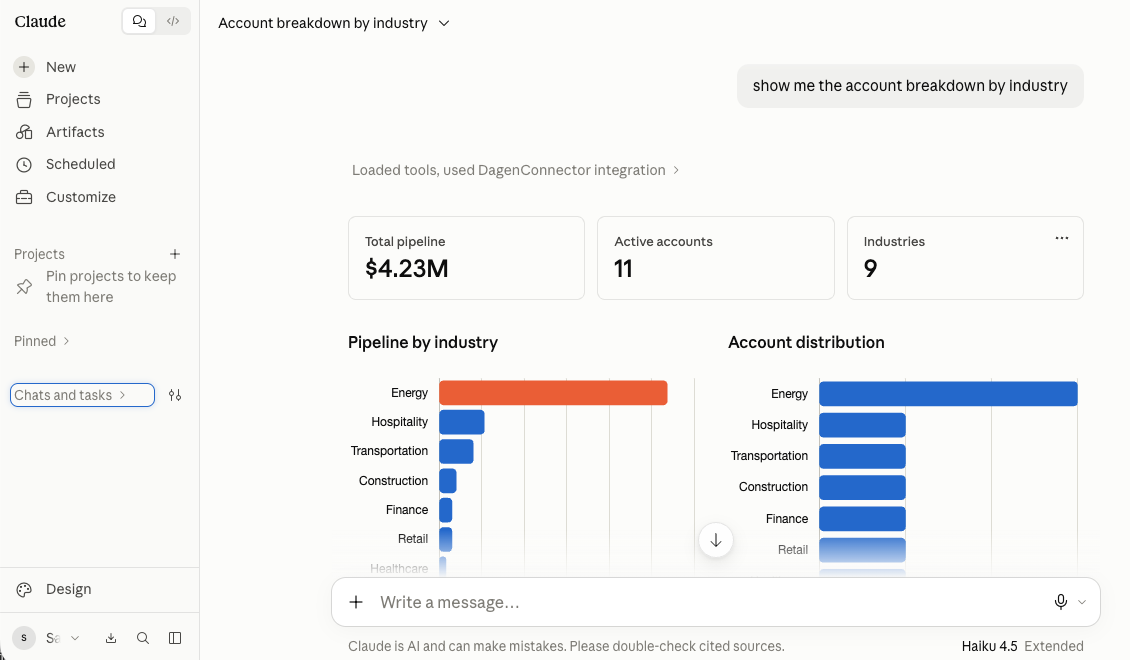
Spark, Iceberg, Redshift, Snowflake, Databricks, BigQuery sit below. Nothing above them knows what pipelines exist, why they exist, or what the data means. Today that layer is a person and a ticket.
The senior data engineer who knows where the customer table actually lives, which of four copies is current, and who’s allowed to see it. That worked when the askers were people. It breaks when the askers are agents. They can’t walk over to someone’s desk.
Connects to the catalog and reads what you already run: tables, views, pipelines, and legacy ETL. Builds a live lineage and dependency graph, classifies PII, and matches it against access policy.
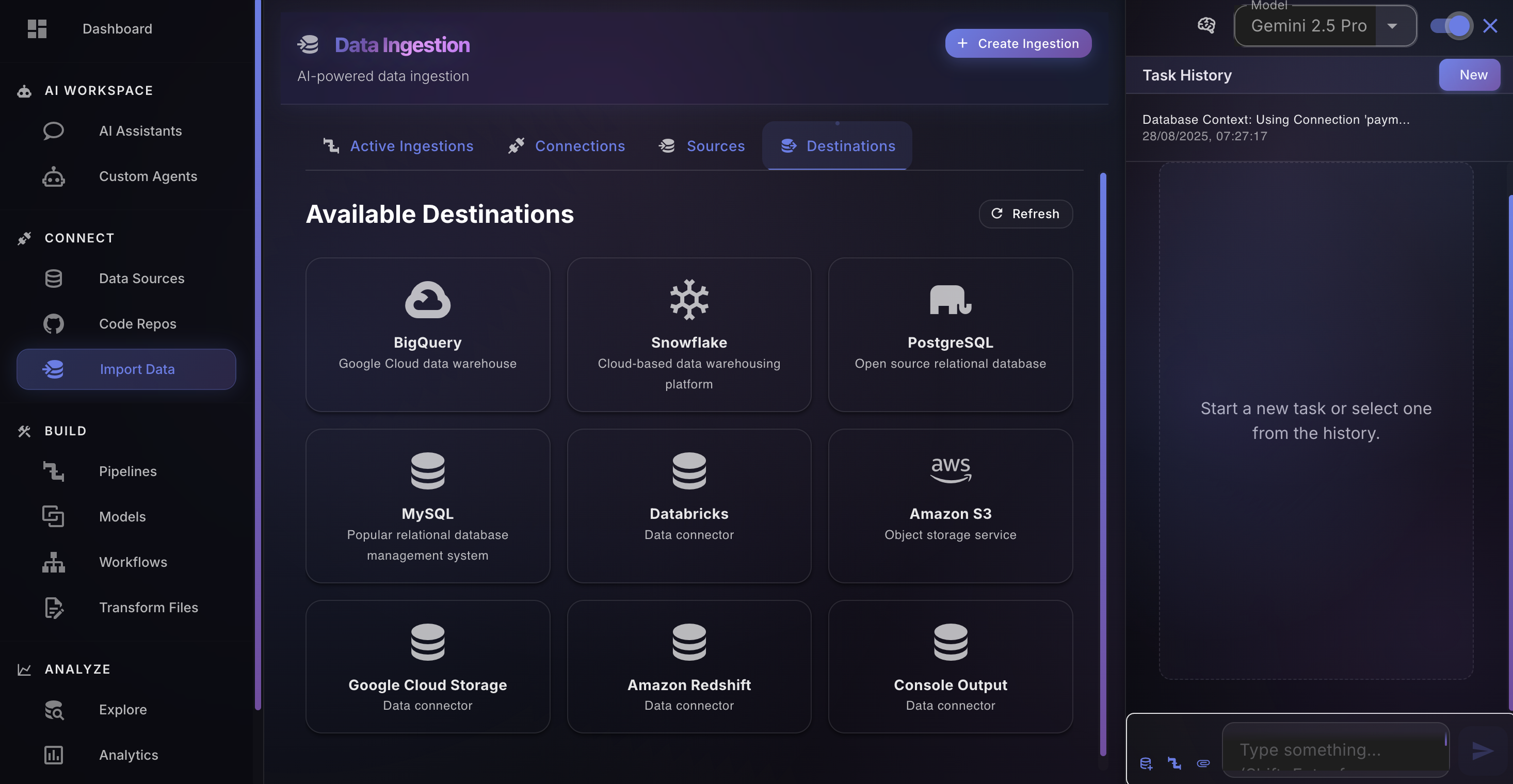
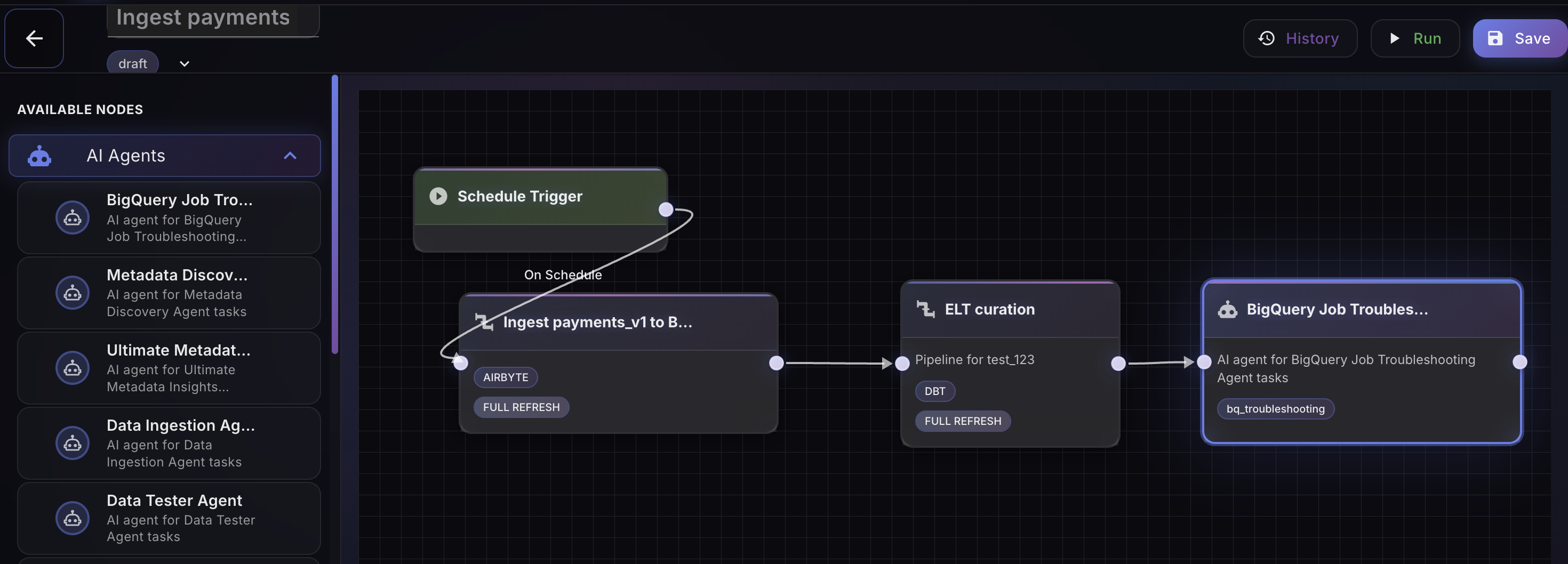
Sequences a dependency-ordered wave plan with effort per wave. Generates human-readable, version-controlled pipeline code — Spark, dbt, SQL, Python — carried forward from the logic you already wrote.
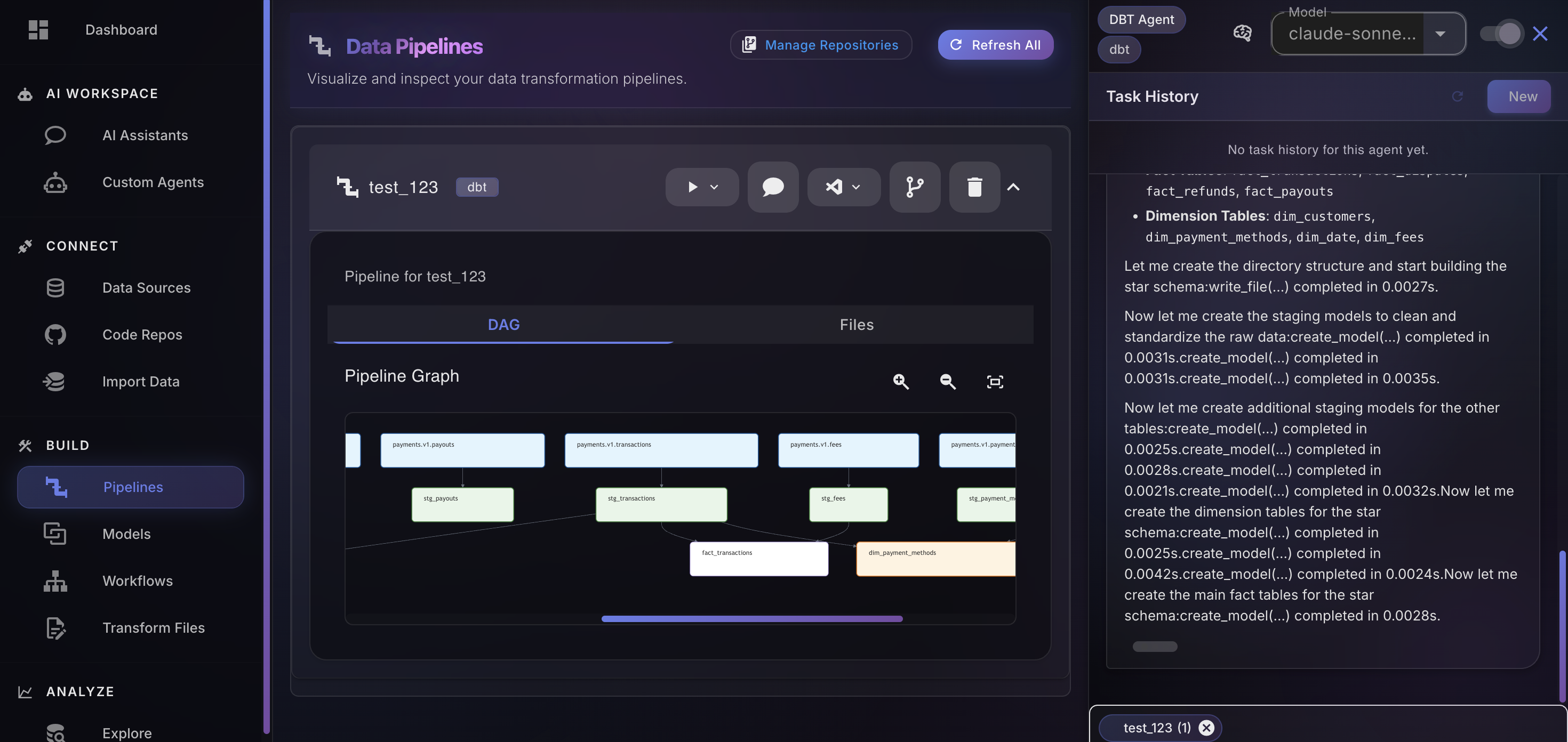
Jobs land on the engines you already own. Glue, EMR, Athena, Spark, DuckDB stay interchangeable behind the map. Dagen decides which one runs each workload. Customers keep every runtime of their own.
Once the map is live, agents get governed answers — allowed, fresh, and traceable. Dagen routes each query to the right engine. If the map does not have it, a proposed task waits for a human yes.
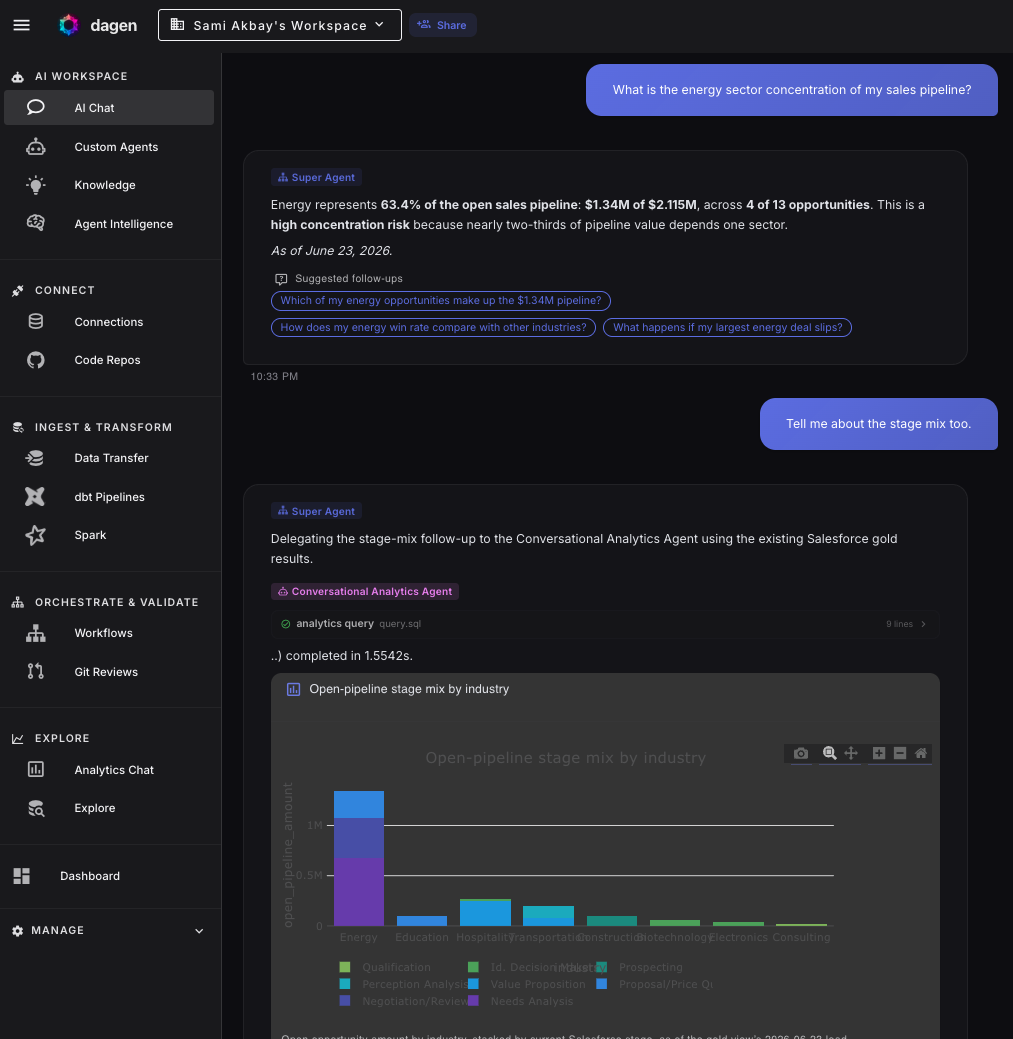
Agent Views sit on the map and serve over MCP. Claude, Copilot, or any MCP client gets answers that are allowed, fresh, and traceable — from the estate you already run, not a curated demo slice.
You Stay in Control
Three operating modes let you calibrate autonomous decision-making to your team's comfort level. Most teams start at Guided and move to Autonomous within 90 days.
Dagen presents options and rationale at every decision point. Engineers remain in full control. Best for teams new to agentic systems or high-sensitivity pipelines.
Dagen handles routine decisions independently and surfaces only architectural choices and significant tradeoffs for human review. The right balance for most production environments.
Dagen executes end-to-end with minimal interruption. Humans are notified only for exceptions, anomalies, or policy violations. For teams that have established trust in the system.
The Compounding Advantage
Dagen's tri-layer memory system transforms every interaction into institutional knowledge. Unlike any point solution, Dagen's value compounds; the longer you use it, the more it understands your data landscape.
The tribal knowledge that typically walks out the door when a senior engineer leaves is instead captured, structured, and made available to every future agent and engineer who touches the system.
The active context for current pipeline tasks: what is being built, what decisions have been made, what exceptions are in flight.
A structured log of best practices directives, rules, remediations, and architectural decisions. Enables accurate and repeatable execution across your entire data estate.
A persistent, organization-specific repository of best practices, architectural preferences, data definitions, and tribal knowledge that accumulates over time and informs every future decision.
Works With Your Stack
Dagen sits alongside your existing tools and cloud providers. Bring your DAGs, your schemas, your warehouses. We add the intelligence layer.
 Snowflake
 Apache
Kafka
Apache
Kafka Amazon Redshift
 Airflow
 Microsoft Azure
 BigQuery
 dbt
dbt Apache
Flink
Apache
Flink PostgreSQL
 Power BI
 Databricks
 GitHub
 Amazon S3
 Apache
Spark
Apache
Spark Kubernetes
 Salesforce
 MySQL
MySQL Apache Iceberg
 Teradata
 Google Cloud Storage
 Apache
Hive
Apache
Hive Azure Blob Storage
 Apache Ozone
 MongoDB
A bank migrated its core banking data warehouse to an Apache Iceberg lakehouse on Amazon S3 with Dagen, automating translation of 1,012 ETL mappings — with measured gains in pipeline velocity, data availability, and validation effort.
Proof
Anonymized under NDA. Oracle Exadata to a hybrid topology of Iceberg on S3 with Glue and EMR and on-premise Hadoop cluster.
| Metric | Before | After |
|---|---|---|
| Time per mapping | 3 days, manual | 3 hours, 86% automated |
| Team and timeline | 6 months, 8 engineers | 1.5 months, 4 engineers |
| Reconciled tables | — | 100% of migrated tables reconciled |
Go from data source to production-ready, AI-native pipeline in a single working session — with full documentation, built-in observability, and autonomous monitoring from day one.
